
What If Your Next RFQ Didn't Take Three Days to Quote?
If an RFQ takes three days to quote, how much of that time is actually engineering judgement? That's the more useful question?

Electrical infrastructure is scaling fast — and most of that pressure hits long before anything reaches the factory floor. It starts the moment an RFQ lands.
Before a panel is built, a breaker ordered, or a transformer released, someone has to turn a stack of customer documents — single-line diagrams, specifications, equipment schedules, drawings, revisions — into something the business can confidently quote. An experienced engineer or estimator has to work out what's current, what's actually required, what's missing, and where the specification quietly contradicts the drawing.
Only once that's done can anyone make a commercial decision.
The real question isn't "how fast can we quote." It's "how much of that time is actual judgement, versus preparation?"
A complex engineered system will always need real technical review — standards interpretation, supplier input, commercial judgement. That's not going away, and it shouldn't. But a lot of what happens before that judgement is repetitive: finding the relevant information across several documents, structuring requirements, cross-checking revisions, building an initial bill of materials, and surfacing the gaps.
Where the time actually goes
A single-line diagram and specification rarely arrive as one clean, consistent source. Requirements are scattered — voltage class, current ratings, short-circuit withstand, enclosure type, protection requirements, customer-specific clauses. Some of it repeats across documents. Some of it conflicts. Some of it simply isn't there.
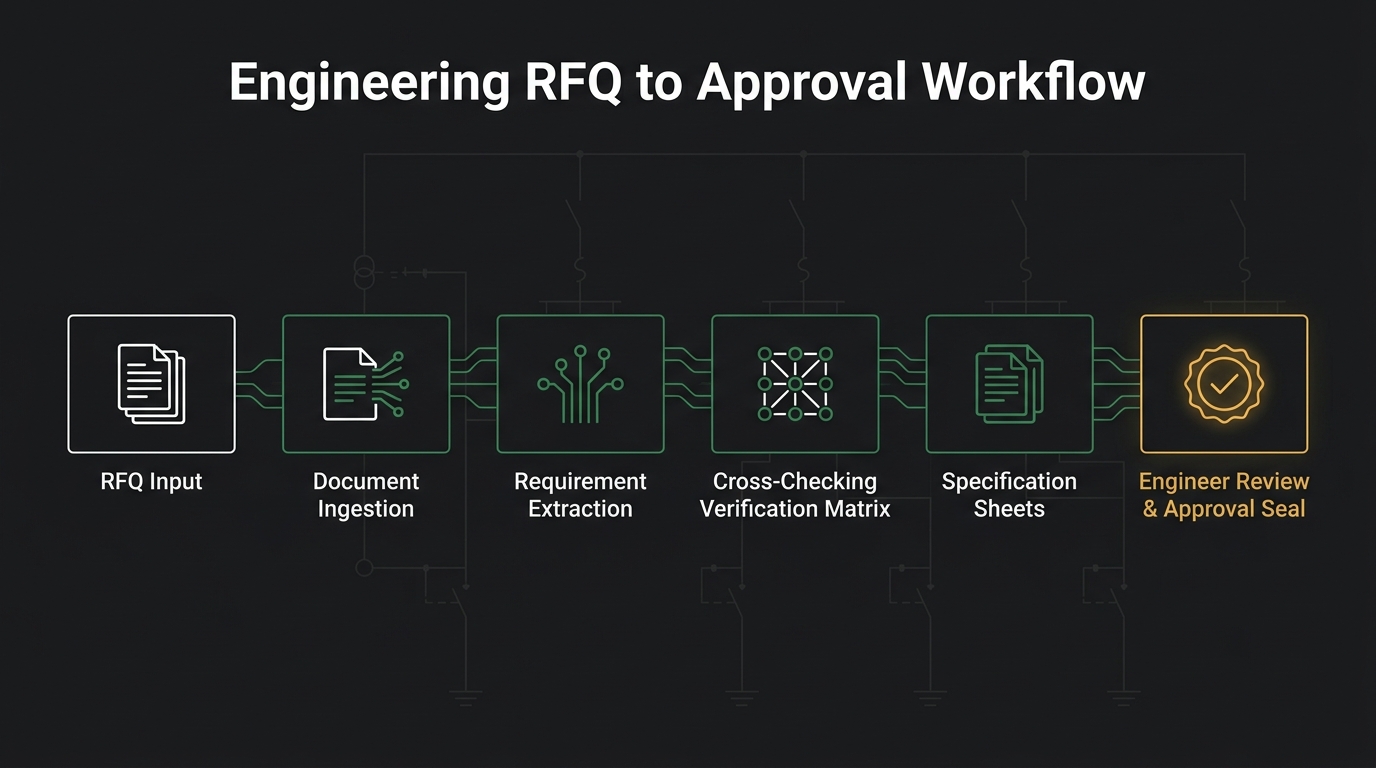
The underlying problem is the same across manufacturers: skilled people are manually converting unstructured customer information into structured quotation inputs — and their judgement genuinely matters. A missing rating, an unclear requirement, a standard the customer's spec doesn't quite align with — those are exactly the points where a person needs to stay in the loop, not get automated around.
This is where Intellium comes in
Intellium — CoralDune's engineering ingestion module — reads drawings, RFQs, specifications and technical documents (DWG, DXF, PDF) and converts them into structured, review-ready data: bills of materials, bills of quantities, and costing-ready inputs.
It goes further than basic extraction. Using engineering heuristics combined with configurable manufacturer rules, it can estimate panel enclosure sizing, section counts, busbar quantities and sizing assumptions, metalwork, and a general arrangement concept — giving estimators both a component BoM and a mechanical enclosure/busbar costing view, inside a single workflow.
Every output stays source-linked. Nothing gets buried — if a value came from page 4 of a spec, that's traceable. Contradictions and gaps get surfaced, not silently resolved. The engineer still reviews, amends, and approves before anything moves forward.

Where PRIME fits in
For low-voltage switchgear specifically, CoralDune's PRIME advisory practice supports the certification side once the technical scope is structured — design review against IEC 61439, rating strategy, certification pathway evaluation, and coordination with test laboratories and certification bodies. The two work together: Intellium prepares the structured technical picture, PRIME helps make sure what gets quoted is also what can be certified.
The point isn't speed for its own sake
Faster output that still requires hours of manual double-checking hasn't actually saved anyone anything. The goal isn't "the computer produced an answer" — it's a result an experienced person can trust quickly: structured in the company's own format, source-linked, gaps flagged, and ready for a human to approve.
When preparation time drops, the real gain isn't just labour saved on one quote — it's capacity. Teams that are currently triaging RFQs, pushing smaller opportunities to the back of the queue, can take on more of the work already coming in without a proportional increase in headcount.
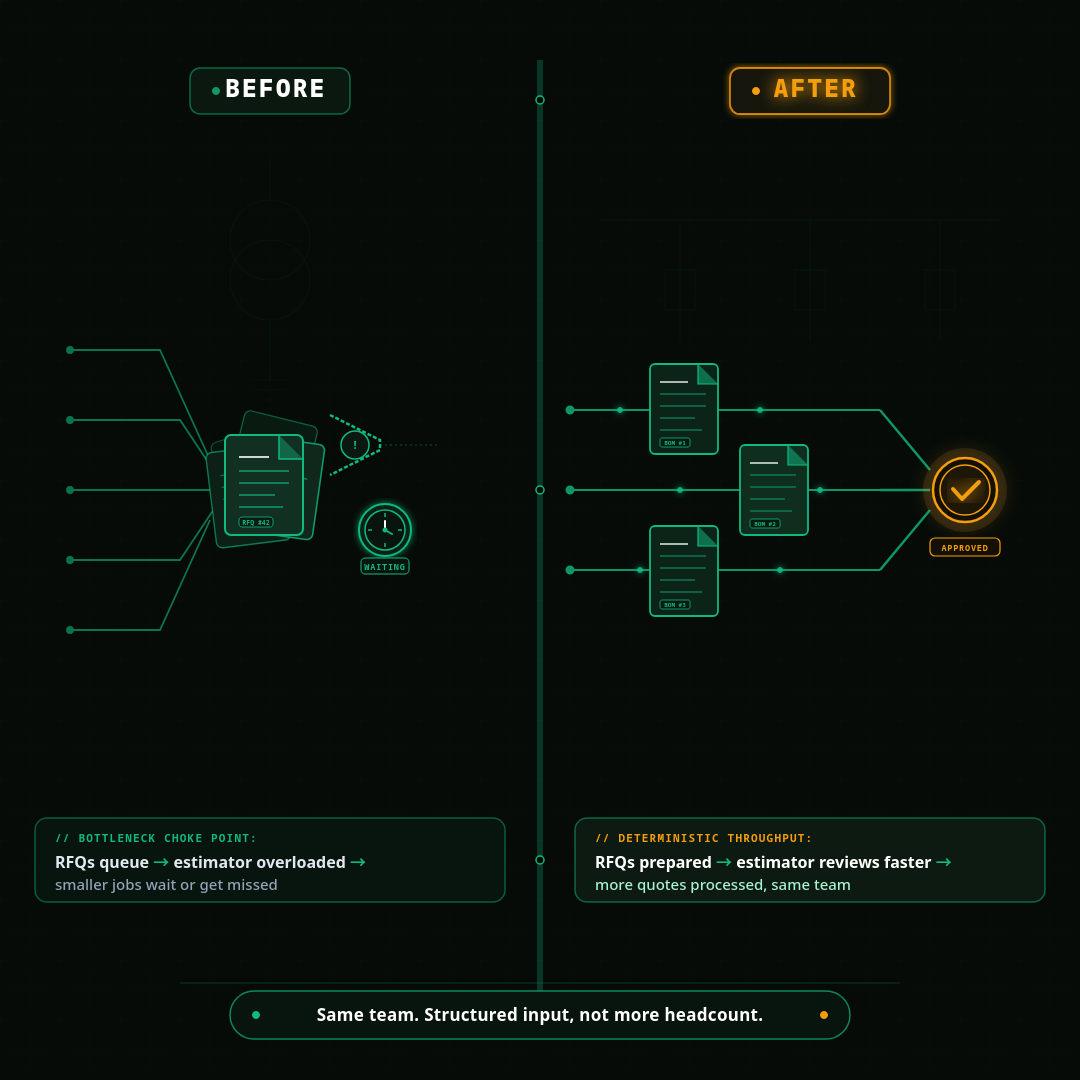
Try it on a quote you've already done
The best way to know if this is useful isn't a generic demo — it's a real comparison. Take an RFQ your team has already completed. Compare the original tender documents against your final output. What could have been prepared before your estimator even started reviewing? What conflicts could have surfaced earlier? What still genuinely needed engineering judgement?
That's a more honest test than watching someone else's demo.
Book a DuneSpan Walkthrough and bring a real RFQ - we'll show you what it looks like structured